
Data Analytics Roadmap for Beginners (2026)
Table of Contents
A Step-by-Step Guide to Start Your Career
Data analytics is one of the fastest-growing career fields in 2026. Businesses across healthcare, finance, e-commerce, manufacturing, education, and IT rely on data to make better decisions. As a result, the demand for skilled data analysts continues to grow.
The good news is that you don’t need years of experience to begin. With the right learning path, regular practice, and hands-on projects, anyone can start a career in data analytics.
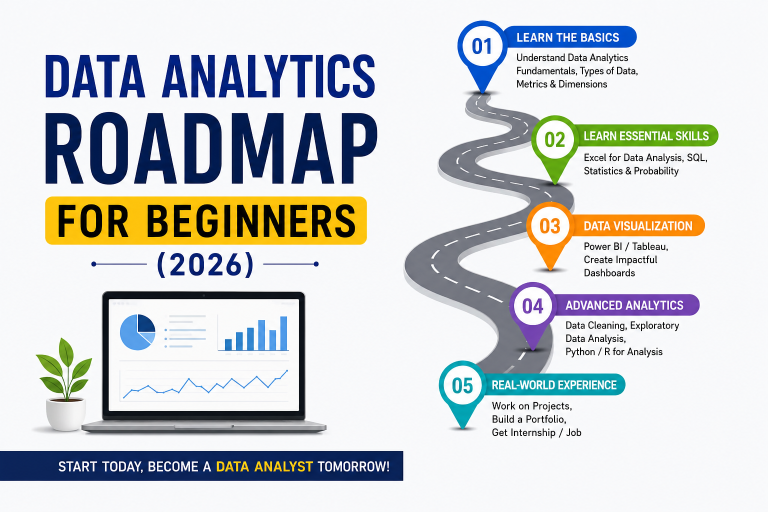
In this guide, you’ll learn a simple, step-by-step Data Analytics Roadmap for Beginners (2026) that can help you build the right skills and prepare for your first data analytics job.
What is Data Analytics?
Data analytics is the process of collecting, cleaning, analyzing, and visualizing data to discover useful insights. Companies use these insights to improve business performance, understand customer behavior, reduce costs, and make informed decisions.
A data analyst works with different types of data using tools like:
- Microsoft Excel
- SQL
- Python
- Power BI
- Tableau
These tools help convert raw data into meaningful reports and dashboards.
Why Choose Data Analytics in 2026?
Data analytics is becoming an essential skill in almost every industry.
Here are a few reasons why many students and professionals are choosing this career:
- High demand across industries
- Excellent salary opportunities
- Multiple career paths
- Opportunities for freshers
- Remote and hybrid job options
- Strong future growth with AI and business intelligence
Whether you are a graduate, a working professional, or someone planning a career change, learning data analytics can open many opportunities.
Excel is the foundation of data analytics.
Before learning advanced tools, understand how to work with spreadsheets and organize data.
Focus on learning:
- Data cleaning
- Sorting and filtering
- Conditional formatting
- Pivot Tables
- Charts
- VLOOKUP and XLOOKUP
- IF functions
- Data validation
Excel is still widely used in companies for reporting and analysis.
mattis, pulvinar dapibus leo.
SQL (Structured Query Language) is one of the most important skills for every data analyst.
Most companies store data in databases, and SQL helps retrieve and analyze that data.
Start with:
- SELECT statements
- WHERE clause
- ORDER BY
- GROUP BY
- HAVING
- JOINs
- Aggregate Functions
- Subqueries
Strong SQL skills can significantly improve your job opportunities.
You don’t need to become a mathematician, but understanding basic statistics will help you analyze data correctly.
Important concepts include:
- Mean
- Median
- Mode
- Standard Deviation
- Probability
- Correlation
- Distribution
- Sampling
These concepts help you understand patterns and trends in data.
Python is one of the most popular programming languages for data analytics.
It allows you to automate tasks and analyze large datasets efficiently.
Start with:
- Variables
- Loops
- Functions
- Lists
- Dictionaries
Then learn popular libraries:
- NumPy
- Pandas
- Matplotlib
- Seaborn
Python is highly recommended for anyone who wants to build a long-term career in data analytics.
Raw numbers are difficult to understand.
Data visualization helps present information clearly using charts and dashboards.
Learn tools such as:
- Power BI
- Tableau
- Excel Dashboards
Focus on creating:
- Sales dashboards
- Business reports
- KPI dashboards
- Interactive charts
Good visualization skills make your reports easier to understand.
Practical experience is just as important as theoretical knowledge.
Build projects like:
- Sales Dashboard
- Employee Performance Analysis
- Student Performance Dashboard
- Retail Sales Analysis
- E-commerce Customer Analysis
- HR Analytics Dashboard
Projects demonstrate your skills and strengthen your portfolio.
A good data analyst doesn’t just create reports—they solve business problems.
Try to answer questions such as:
- Why did sales increase?
- Which products perform best?
- Which customers are leaving?
- How can the company increase revenue?
Understanding business goals makes your analysis more valuable.
Create a professional portfolio that includes:
- Excel projects
- SQL queries
- Python notebooks
- Power BI dashboards
- Tableau visualizations
Upload your work to GitHub and create a strong LinkedIn profile to showcase your skills.
Once you have completed projects, start preparing for interviews.
Practice:
- SQL interview questions
- Excel interview questions
- Python basics
- Power BI interview questions
- Business case studies
Also prepare your resume and be ready to explain your projects confidently.
Technology changes quickly.
Continue learning about:
- Artificial Intelligence
- Generative AI
- Machine Learning
- Cloud Analytics
- Microsoft Fabric
- Data Engineering basics
Continuous learning will help you stay competitive in the job market.
Best Skills Required for a Data Analyst
A successful data analyst should have:
- Microsoft Excel
- SQL
- Python
- Power BI
- Tableau
- Data Cleaning
- Data Visualization
- Statistics
- Critical Thinking
- Communication Skills
- Problem Solving
- Business Analytics
Common Mistakes Beginners Should Avoid
Many beginners make mistakes that slow their learning.
Avoid these common errors:
- Learning too many tools at once
- Ignoring Excel basics
- Not practicing SQL regularly
- Skipping real-world projects
- Focusing only on certificates
- Not building a portfolio
- Avoiding interview preparation
Learning consistently is more effective than trying to learn everything quickly.
Career Opportunities After Learning Data Analytics
After completing your learning journey, you can apply for roles such as:
- Data Analyst
- Business Analyst
- Reporting Analyst
- MIS Executive
- Business Intelligence Analyst
- Power BI Developer
- Junior Data Scientist
- Marketing Analyst
- Financial Analyst
- Operations Analyst
These roles are available across startups, multinational companies, banks, healthcare organizations, retail businesses, and IT companies.
Data analytics is one of the best career choices in 2026 because organizations are becoming increasingly data-driven. If you follow a structured roadmap, practice regularly, and build real-world projects, you can confidently start your journey toward becoming a successful data analyst.
Begin with Excel, master SQL, learn Python, create interactive dashboards in Power BI, and develop a portfolio that showcases your skills. Along with technical knowledge, focus on problem-solving and communication, as these are highly valued by employers.
If you’re looking for a Data Analytics Course in Indore with practical training, live projects, and placement support, choosing a structured training program can help you learn faster and prepare for real industry requirements.
Start today, stay consistent, and take one step at a time. Every expert data analyst was once a beginner.